- 22 mei 2018
The power of compassion in change management
- Johanna Koopmans
By: Johanna Koopmans – as published May 22, 2018 on LinkedIn
Why is compassion so important in change management and how can we practise compassion in the organisational context?

As a professional in the space of organisational change we all meet those stereotypes in our work once in a while. The ‘Yes, but’ people that dive in to a hundred reasons why the new way of working will not work and being asked one simple question suffocate you in a cloud of technical mist. The ‘passive endurer’, that will not undertake anything unless you chase them, or the pointing ‘Why should I, if they don’t?’ employee. Before you know it, an impatient thought popped up saying: “Nja-nja-nja… What a nag!!” after such an encounter. On such occasions I remind myself instantly of my coaching mantra, a basic underlying premises of compassion.
“All people will act according to their best possibilities within their perspective and have reasons to respond the way they do.”
As a change facilitator with a task to move people (and thus to understand their behaviour) permanent residence in this place of non-judgment is really needed. This mantra makes me instantly aware it was actually a meeting with myself, with my own impatience and allergy to attitudes of powerlessness.
Dealing with the emotive side of change
In the workplace in flux it is often regarded easier to distance yourself from people by labelling their actions as passive, unmotivated, or, counterproductive than to delve in to the reasons why. It is therefore rather observable that negative emotions – such as anger and fear – are frequently not properly dealt with or incorporated into organisational responses on the side of change. These unlikeable expressions are rather dismissed and overpowered by a positive narrative.
“What is the future of our department looking at the direction our company is taking?”
asked an employee in a QanA with the C-level executive responsible for the change. Hereby he was clearly expressing the underlying fear that all working with in the old framework would become superfluous when the new technologies embraced by the strategy are implemented. The executive’s answer concentrated on a
“great reskilling path designed for all involved in the to be decommissioned technologies”.
Now take a moment to close your eyes and tap in to the fear of being a 60 year old expert working on the same technology for 20 years. Would you feel at ease with this answer?
Happiness is not the answer
If we dissect his interaction we see 1. voiced fear (expression of emotion) directly followed by 2. positive narrative (provide a solution). Actually, you could recognize the kind of interaction in which it often derails between women (sharing emotion) and men (providing a solution). So why, if this misunderstanding is as old as mankind, do we still make this erroneous jump to conclusions in the researched field of organisational development? In our attempt to provide immediate solutions, we actually are not compassionate at all by ignoring the basic problem exploration and confirming if there is indeed an issue. We should take into account that happy face band aids really don‘t heal the sore.


Emotions of fear, anger and grief caused by loss of a known status quo should not come unexpected in the change arena. The stress perceived by a significant change in work or organisation lingers between the death of a near friend and gaining a new family member in the Holmes and Rahe Life Stress Inventory. You can tell people rationally that a change is going to be good, it is still going to be stressful for most. Although organisational change research is increasingly abandoning a process-driven change perspectives in favour of a people-driven view, there is still a great potential to use more generally accepted change tools on the work floor that address this emotive reality.
Speeding up by slowing down
The obvious reflex we tend to see in organisations where the speed of change adoption is not perceived or measured as sufficient is pushing harder, intensifying programmes and capacity. Such efforts are feeding the shadow side of the organisations in case the official change narrative and its shadow version diverge significantly.
When feelings and meanings start to multiply in proverbial petri dishes, organisational silence may be witnessed. This is a non-response to change and continuation of business as usual underneath the new veil due to a disruption of thoughts between organisational layers. How to resolve this situation? Instead of accelerating this might be the moment to practise professional compassion. Shining light on those emotive systems in the organisation can be done by de-accelerating and letting the shadow side surface. This can release the stagnated energy that is needed to regain the momentum of your change. Be aware, this does not involve tolerating refusal of change. It is rather about entering the informality of organisational behaviour and culture, incorporating it, and, providing an answer.

Operationalising compassion as a step to true change. What is compassion?
I would like to argue that in order for change to be fundamental – change programme representatives need to show compassion in approaching the workforce. Compassion tends to be misunderstood in the organisational context. I regularly encounter managers that avoid conversations out of ‘compassion’. They talk to colleagues about non-functioning people (defined in relation to their changed role) under their responsibility and are even preparing measures. Meanwhile they did not initiate that face-to-face conversation with the subject addressing the topic without any detour. Is this true compassion or is it a discomfort to confront?
Compassion is not about being lenient with or to spare people. It also does not involve tolerating refusal to the change. It is about being sensitive to people’s considerations and responsiveness in the chosen trajectory to the change objectives. To address worries is therefor to effectively create and maintain the human connections needed to function as infrastructure to (create the leeway for and) sustain change in organisations. Functioning human connections form the basis of change. In order to be mobilised, people need to understand their role in the change and what it practically means for them.
A definition of compassion I found most helpful for use within organisations is the following breakdown of compassion of Marc Lesser, CEO of the Search Inside Yourself Leadership Institute (SIYLI), into these three domains:
1. Empathy – Feeling as somebody else if feeling (however uncomfortable);
2. Cognition – Seeking to understand what someone else is thinking and why they came to hold their opinion (requiring mindful listening);
3. Motivation – Trying to take care of the concerns of others and reduce their suffering.
Following this, the most compassionate professional behaviour is to inform on and acknowledge what is there, leave space for a response/worries, and to respond in a way that reflects active listening and absolves mutual suffering. Usually the people we hesitate to address actually don’t act as we expect, but instead will respond reasonable when they feel taken seriously and included.

Compassionate messages
A regular engagement error on leadership level in change trajectories is not wanting to distress people with messages while still working on the solution. Meanwhile a “we are working on it”-message is sometimes more transparent and humane than a great gap of silence followed by a so-called big bang solution. Showing the human side, and there for being able to leave room for not knowing – or even failure – is detrimental to access the communal space of trial and error preceding professional change. In addition to making a clear underestimation of the sensory abilities of the average employee, wait-to-share creates a bypass on the great potential of employees who will have ideas too about the best solution – being the one with first-hand experience.
This example might trigger the question: Does transparency perhaps equal compassion? My mind goes back to a job interview I had. I was at the end of a long selection day for a consulting role I really wanted. The wait for my final verdict was taking really long and I therefor suspected that the outcome would be at least complicated. The first thing my interviewer said upon return was “I am afraid the outcome is not good, we cannot hire you”. I already felt this was coming and his unscrupulous approach consisting of:
Addressing the issue at hand;
Short analysis/description of the issue;
The possible effects for me and them if decided differently;
Room for response and reflection and emotion on my side;
Common outlook on the future and possible actions.
really made me feel respected as a full-fledged conversation partner and valued. Although the outcome was not as hoped up front, I left the building in an elevated mood. Not wanting to reduce the complexity of organisations in transformation to an interview setting, it did make me wonder if this compassionate dialogue sequence could serve as a basic format for change communication.
Compassionate action
The momentum of change trajectories creates opportunities for leaders to make renewing and effective policies by applying their compassion. Compassionate action start with self-reflection. Do your change interventions start from a place of trust in the good? Do they rightfully address how you would like to be treated yourself? Moreover, it includes embracing that your design should involve opportunity for redesign. Because closing the feedback cycle, is essentially leaving space for reaction and showing to your employee what you are taking on board from his reaction and what not (and why). Doing just that is compassionate action.
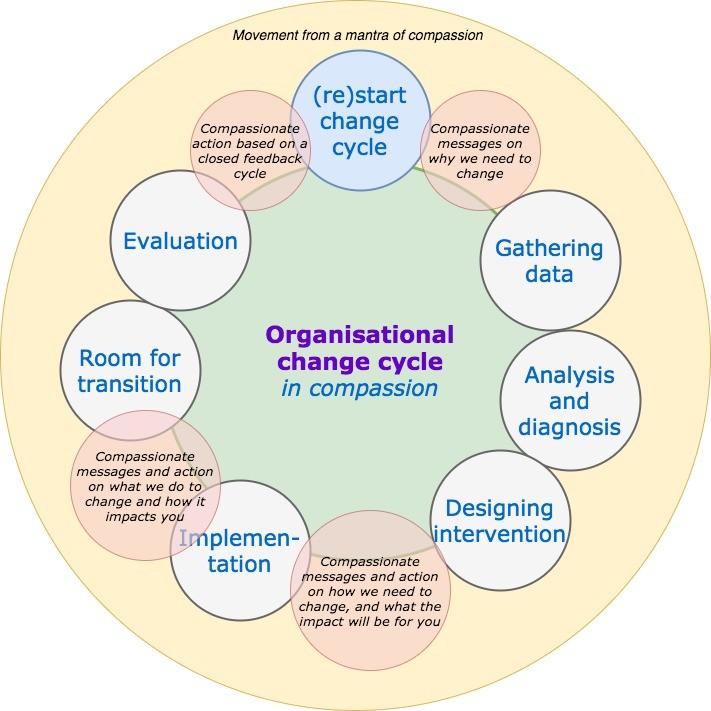
To conclude
Employing compassion helps you understanding why people behaving as they do, accommodate the reaction, addressing the reasons and tapping into the possibility to change attitudes and open the way to profound organisational change. How could you involve compassion in your organisational change?
Adopt a mantra of compassion for yourself as change practitioner. More practically; Think about how to embed compassion in your change model or supporting set of values;
Employ models with time for problem exploration and facilitation methods that include the emotive reality of the people touched by the change;
Two-way communication is key as it strengthens the interhuman connections that are the transmission cables for adopting change;
Pause to acknowledge the situation of where you are. The intermediate stations of change are usually imperfect. Don’t be afraid to voice the lessons learned and the black holes to be uncovered;
Don’t strive for big solutions and only communicating secure outcomes. Instead provide the start of a solution with room for co-creation by your audience.
Questions for reflection
Reflect on what compassion means in your organisational change? Do the change ambassadors in your organisation behave truly compassionate? How is compassion institutionalised in your processes?
What means do you use to enter the informality of organisational behaviour and culture? How do you feed it back in to your formal approach?
What change models and tools or working formats are you familiar with that operate from, or take into account, this emotive reality?
Please feel welcome to share your thoughts and insights on this topic. Let’s create some compassionate change together!
Future Grounds, May 2018
#change #change management #compassion #organisational change #organisations